OSCILLATOR
The raw tone
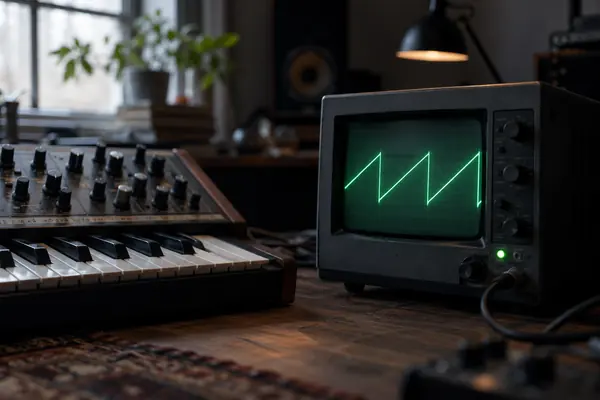
An oscillator repeats a single cycle of a waveform to make a steady tone at the pitch you ask for. Sine, triangle, square and sawtooth are the traditional shapes.
Compare waveforms doodlesynth
HOW SYNTHS WORK
Every synth sound begins as a repeating wave.
Try a waveform
WAVE · FILTER · SHAPEthe classic signal path
An oscillator makes the raw tone, a filter takes away the parts you do not want, and an envelope shapes how loud it is from the moment you press a key to the moment it fades.
At a glance
1964–65
A modular prototype synthesizer
The Henry Ford museum holds a prototype synthesizer made by engineer Robert Moog with composer Herbert Deutsch. Its solid-state design was more portable than earlier vacuum-tube systems.
THE HENRY FORD · USA
£330
UK price of the VCS3 in 1969
The Science Museum calls the VCS3, made by EMS, more or less the first portable commercially available synthesizer. Earlier machines filled large cabinets, some whole rooms.
SCIENCE MUSEUM · LONDON
TWO DATES WORTH KNOWING
Two machines now held by museums
show how fast synths shrank in the 1960s.
The Henry Ford notes that the 1968 album Switched-On Bach brought the Moog synthesizer to a wider audience, and synthesizers quickly became a mainstay of popular music.
A QUICK WAVEFORM CHECK
Pick a waveform to see which harmonics it contains. The bar shows how much high-frequency content there is for a filter to work on.
Based on Toby Rush's open music theory text on electronic sound and Indiana University's synthesis course notes.
THE SHORT ANSWER
The classic method is called subtractive synthesis.
It runs through three simple stages.
OSCILLATOR
An oscillator repeats a single cycle of a waveform to make a steady tone at the pitch you ask for. Sine, triangle, square and sawtooth are the traditional shapes.
Compare waveformsFILTER
A low-pass filter lets the low frequencies through and turns the high ones down. Lower the cutoff and the sound gets darker and warmer.
How filters workENVELOPE
An envelope sets how a note starts, settles, holds and fades. The classic four stages are attack, decay, sustain and release.
Build a sound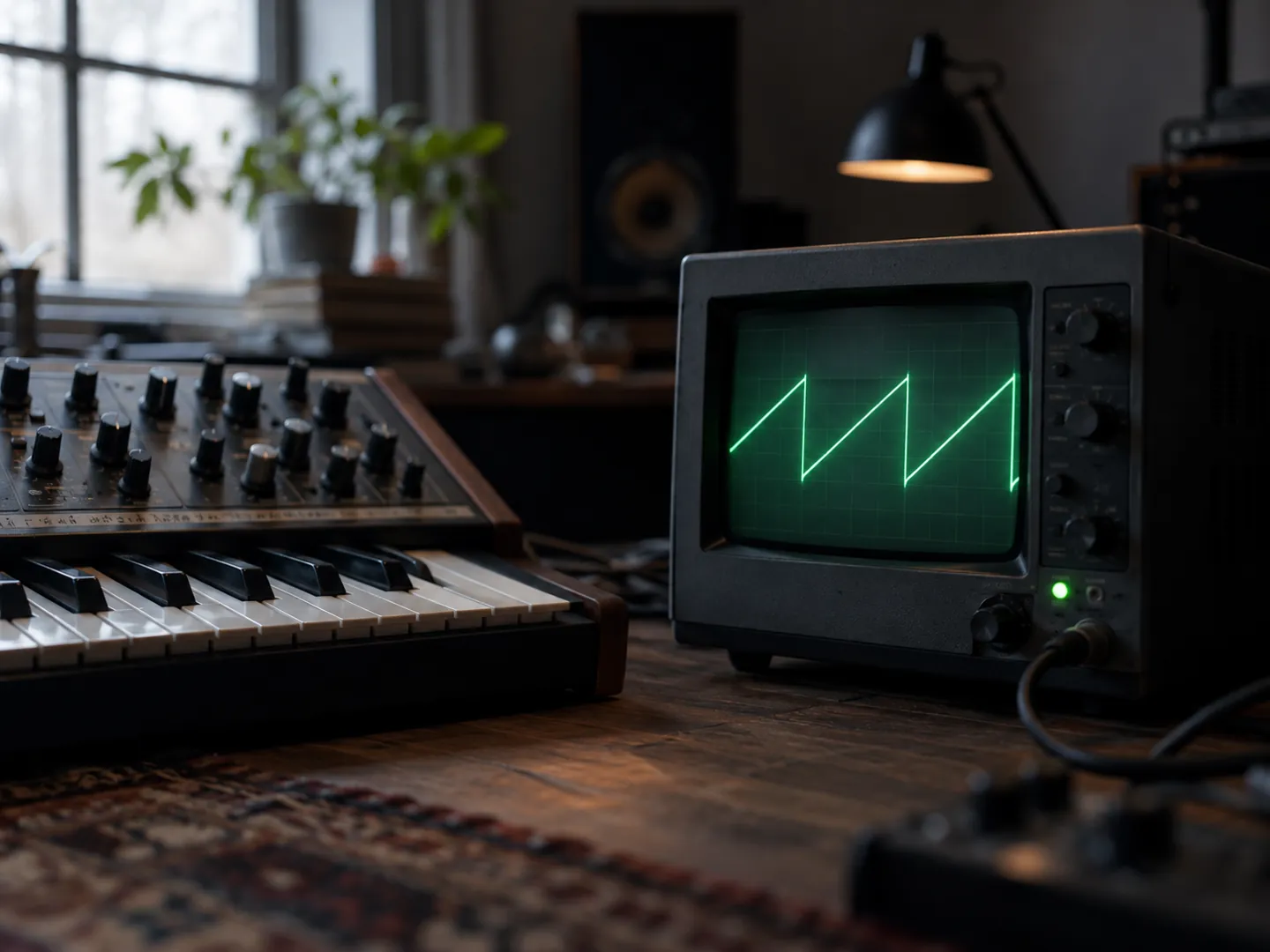
FOUR STEPS TO A SOUND
These steps work on almost any subtractive synth, hardware or software. Change one control at a time and listen.
Start with a sawtooth. It is full of high harmonics, which gives the filter plenty to shape.
Turn the low-pass cutoff down until the buzz turns warm. Higher sounds brighter; lower sounds darker.
Resonance adds a peak just below the cutoff, making the filter's effect more pronounced.
Set how fast the note starts, how it settles, the level it holds and how long it fades after you let go.
FILTERS AND ENVELOPES
The cutoff frequency is where a filter starts to turn frequencies down. On a low-pass filter, everything below it passes unchanged, and resonance adds a peak just below it, making the filter's effect more pronounced.
In an ADSR envelope, attack starts when you press a key, decay follows, sustain is the level the note holds while the key stays down, and release begins when you let go and lasts until the note is silent.

Questions
An electronic component that turns a direct current into one that alternates at a set frequency. In a synth it repeats one cycle of a waveform over and over to produce a continuous tone at the pitch you play.
The classic way to make synth sounds: start with a bright waveform full of harmonics, such as a sawtooth, then remove parts of its spectrum with a filter to shape the tone.
They are the four stages of the traditional envelope. Attack, decay and release are times; sustain is a level, the strength of the note while the key is held after the decay.
A sine wave has only one frequency. A sawtooth contains all the harmonics of the base note, at falling strengths, so it has far more high-frequency content.
The Science Museum describes the EMS VCS3 of 1969 as more or less the first portable commercially available synthesizer, a year before the Minimoog and ARP 2600. In the UK it sold for £330.
Sources
ABOUT THIS NAME
doodlesynth.com is part of the DoodleSale portfolio. It isn't in an auction right now, but you can ask about leasing it.